
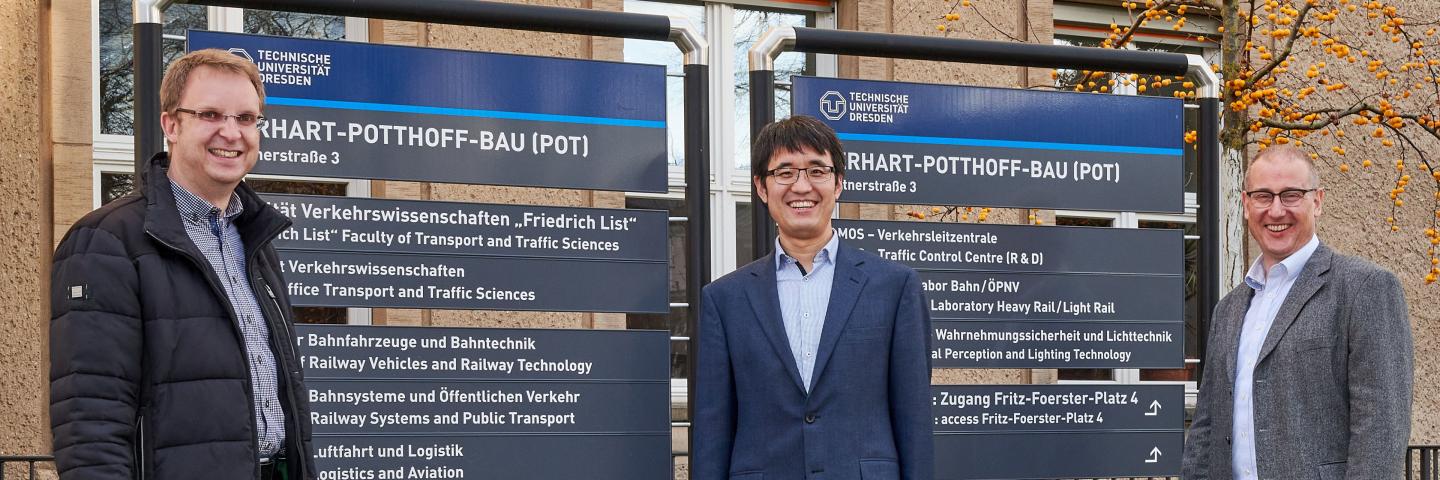
\"My Goal: Leading the chair towards an internationally recognised group in traffic control of multimodal traffic processes\"
Strengthening for the professors of the "Friedrich List" Faculty of Transport and Traffic Sciences: Prof. Dr. Meng Wang (41) was appointed head of the Chair of "Traffic Process Automation" at the Institute of Traffic Telematics on 1 December 2021.
The faculty members and staff welcome him warmly and wish him a good start.
Shortly before he moved from the Delft University of Technology/Netherlands to Dresden, he gave an interview about his reasons for applying, his research focus and his goals as the new head of the chair.
Prof. Wang, what was the deciding factor for you to apply for the Professorship for Traffic Process Automation at TU Dresden?
Prof. Wang: After working 12 years at the Delft University of Technology, I want to take a new challenge and was looking for a suitable professorship and development opportunities for me. When I read the dedication and focus of the professorship - the key words were "traffic control" and "connectivity" - I immediately had the feeling that I’m exactly fulfilling the profile due to my research focus and my strong experience in this area.
What are your research areas?
Prof. Wang: In summary, my research focuses on how mathematical models and data can be used to understand the impacts of disruptive technologies such as vehicle automation and connectivity on traffic processes and to control individual and collective behaviours of vehicles in order to optimise traffic efficiency, safety and sustainability, for example.
Do you see any links to the TU Dresden's Strategy of Excellence 2028 and the potential areas named therein that are to be further developed? The potential area "Automated and networked mobility" is linked to the Faculty of Transport and Traffic Sciences.
Prof. Wang: Yes, absolutely. That was an important topic during the application interviews. My research in recent years on the optimal and safe interactions of connected and automated vehicles in “mixed traffic” and the connection of traffic dynamics at the microscopic and macroscopic levels, has created important foundations - and has been taken up many times by other researchers worldwide or has stimulated further research. My research was and is of a very multidisciplinary nature. This helps me to understand and design traffic control measures. With regard to automated and networked traffic systems, I strongly believe that user behaviour and sustainability should be the top priorities in their design. I would like to bring these into the development of the potential area.
Where were research projects of yours located in the past years? Who has used the results?
Prof. Wang: These often involved the management and control of future transport systems with disruptive technologies of vehicle automation, communication and electrification. Two examples of this: One current EU project, SAFE-UP, is about proactive safety systems and metrics to identify safety critical scenarios of automated vehicles in mixed traffic. Another EU project, DiREC, funded by CEDR, is about supporting national road authorities to evaluate their future physical and digital infrastructure to facilitate connected and automated driving. Clients included government agencies, motorway operators, or well-known car manufacturers (OEMs) and suppliers.
What role does the "human factor" play in your research?
Prof. Wang: An increasingly important role. User behaviour is an important factor in the development of traffic systems. Automated driving is not only about technology, but also about social behaviour. Human drivers and vulnerable road users meet and interact automated systems. In our research, we use high technology to study human behaviour. That's why I'm very pleased that the Faculty of Transport and Traffic Sciences at TU Dresden also has a Chair of Traffic and Transport Psychology. Here I see links to my professorship - as well as, of course, to the other colleagues in the faculty.
Have you already made contact with other Scientists at TU Dresden?
Prof. Wang: Yes, there have been some exciting exchanges for a start, including with Prof. Regine Gerike, Prof. Oliver Michler, Prof. Günther Prokop and Dr. Martin Treiber, all at the "Friedrich List" Faculty of Transport and Traffic Sciences. I also see close connections with Prof. Marc Timme from the Center for Advancing Electronics Dresden (cfaed), Prof. Frank Fitzek and Prof. Gerhard Fettweis from the Institute of Communications Technology or also Prof. Christoph Sommer from the Chair of Networked Systems Modeling at the Faculty of Computer Science.
If we would have a crystal ball and could see 5 to 10 years ahead. How would you like to be positioned with your professorship then?
Prof. Wang: With the professorship, I aim to develop as a world leader in traffic control of multimodal traffic processes enabled by networked and autonomous systems. This includes interdisciplinary research, the education of competent and responsible students and the transfer of knowledge as well as engineering and design solutions for public and private stakeholders. One focus will be the development of new theories and models of future traffic flows based on machine learning and artificial intelligence. Furthermore, at the professorship we will deal with Cooperative and Autonomous Vehicles (CAV) and swarm intelligence, in particular with decision and control methods for deriving traffic signals and CAV manoeuvre plans for an efficient, energy-saving and safe traffic flow.
What are your plans regarding the research infrastructure at your chair?
Prof. Wang: For the above-mentioned goals, a good research infrastructure is essential. My research so far has been very much concerned with the theoretical models and algorithms for the control of future transport processes. The implementation of my research results in practice is at the very beginning, because the topic is so new. In order to show societal users the potential benefits and implementation in practice, an excellent laboratory and simulation environment is needed in the form of simulating, scaling and living laboratories. To this end, on the one hand, the existing Control Centre Laboratory and Dresden Traffic Management System (VAMOS) is to be expanded into a Traffic and Environment Monitoring and Control (TEMC) lab. A Connected and Automated Vehicle (CAV) fleet and a Scaled Autonomous and Networked Mobility (SANM) lab are also planned. All this new research infrastructure will of course also be open for collaboration with other chairs, especially at the faculty, My goal is to implement joint interdisciplinary projects there.
Are these labs also available to students?
Prof. Wang: Absolutely. I don’t consider research and teaching separately. It is very important to me that my students come into contact with current research and application topics already during their studies – and that in a very practice-oriented way.
How is that reflected in your teaching concept?
Prof. Wang: In my Bachelor’s and Master’s courses, I combine teaching content with socially relevant problems. Starting with a practical traffic problem, the students are supposed to look for solutions using state of the art theories and methods under my guidance. Getting to know and using the laboratories is part of this. Active learning and the realisation that what they learn is important in practice are my teaching approaches. So far, this was very well received by my students in Delft. I see myself as a guide and monitor for my students.
You are moving from Delft to Dresden for the professorship. Have you ever been to the city?
Prof. Wang: Actually, I was in Dresden a few years ago – from April to June 2012 during my PhD. As part of a project, I developed a model to describe adaptive cruise control and cooperative adaptive cruise control systems based on optimal control theory. For this, I worked for three months with an expert in the field at TU Dresden, Dr. Martin Treiber from the Chair of Econometrics and Statistics, esp. in the Transport Sector.
What are you looking forward to besides the new professional challenge?
I have fond memories of Dresden's museums and galleries from my visit in 2012. I was also in Saxon Switzerland at the time. I'm looking forward to that. In addition, Dresden has a nice size and variety as a city - bigger than Delft and "slightly" smaller (laughs) than Beijing, where I grew up. And for my hobbies - playing football, cycling and travelling - Dresden is also a wonderful place. My family and I are looking forward to move here.
Content
Originalautor
Interview: Anke Richter-Baxendale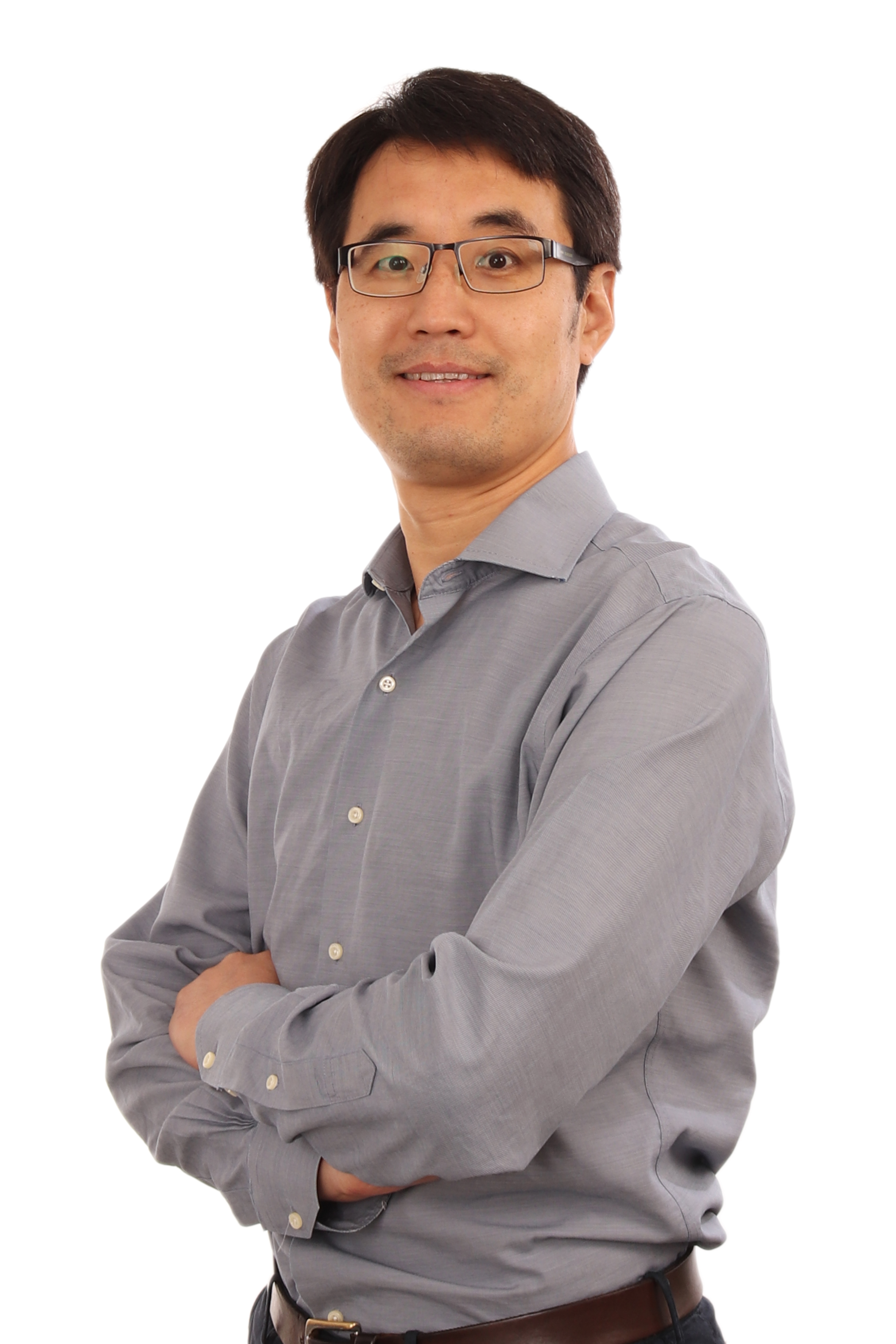
Chair of Traffic Process Automation
"Friedrich List" Faculty of Transport and Traffic Sciences
Mail: meng.wang@tu-dresden.de