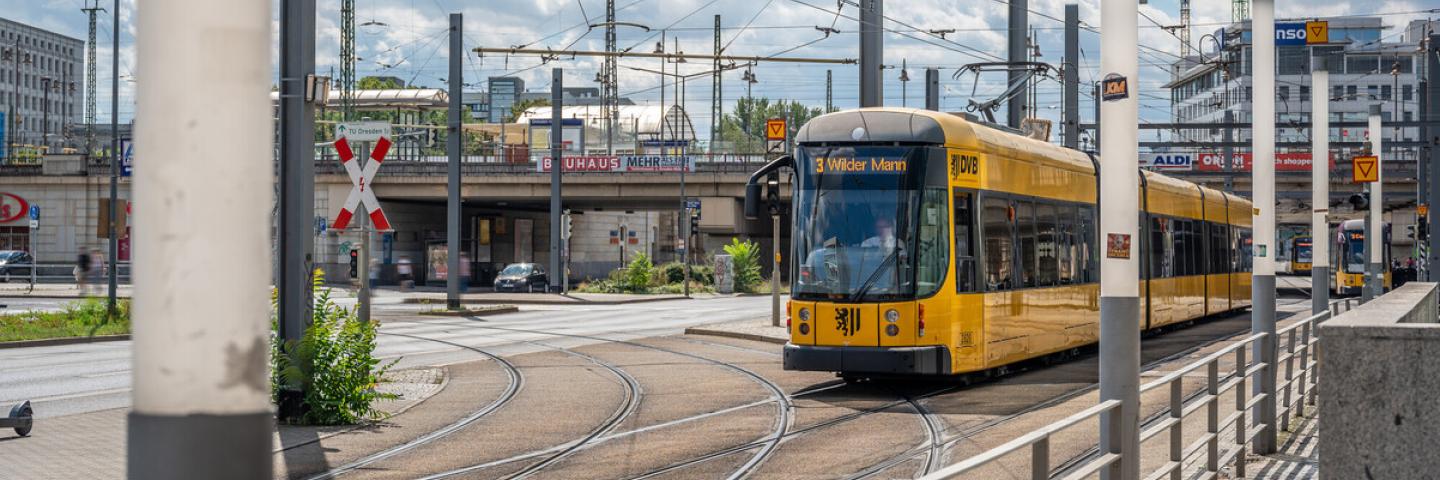
PrioPoint: Making Public Transport priority at traffic lights more efficient with dynamic detection points
How can public transport be given priority at traffic lights without unnecessarily slowing down other road users? This is the question addressed by the PrioPoint research project. At its core is the investigation of dynamic detection points that could enable buses and trams to receive more targeted priority at traffic signals in the future.
The sustainable transformation of urban mobility requires a stronger shift towards environmentally friendly modes of transport. Alongside cycling, walking and micromobility, public transport plays a particularly important role. At traffic lights, however, the different modes of transport compete for a limited resource: available green time. Giving public transport targeted priority can help make it more attractive and reliable.
Getting the Timing Right
A key factor is when a public transport vehicle is detected by the traffic signal control system. This is done via so-called detection points. If a detection point is located too far from an intersection, the priority request may be triggered too early. If it is positioned too close to the traffic lights, there may not be enough time to adjust the signal programme effectively.
This is where PrioPoint comes in. The project investigates whether dynamically adjustable detection points could provide a cost-effective alternative to existing approaches. The aim is to adapt the detection point to the prevailing traffic situation and thereby reduce delays for public transport while avoiding unnecessary disruption to other traffic.
Simulation Based on Real-World Traffic Data
To investigate this approach, existing traffic signal control programmes at selected intersections will be integrated into a simulation environment. Based on real-world measurements of incoming traffic flows, the researchers will analyse how dynamic detection points affect waiting and delay times under different traffic conditions.
The project is not only concerned with whether dynamic control can be implemented from a technical perspective. Rather, it aims to quantify the effects of different strategies on the overall traffic system and identify the conditions under which dynamic priority is particularly beneficial.
Research in Close Collaboration with Practice
PrioPoint is being carried out in cooperation with the City of Leipzig's Office for Mobility and Civil Engineering and Leipziger Verkehrsbetriebe (LVB). During the first project phase, running from January to December 2027, the focus will initially be on establishing the legal, administrative and technical conditions required to provide the necessary data.
The project thus combines scientific methods with the practical requirements of urban transport planning. Its findings are intended to help assess new opportunities for making public transport priority at traffic signals more efficient and targeted.
Content
Dipl.-Ing. Matthias Körner
PrioPoint is funded by the German Research Foundation (DFG), project number 589846560.