The “RadSim” digital platform helps municipalities plan better cycling infrastructure
How do new bike paths, bike lanes, or traffic-calming measures change bicycle traffic in a municipality? Which infrastructure measures are adopted by cyclists and encourage people to enjoy riding their bikes? Answers to these questions are provided by RadSim, a new web platform from the Technical University of Dresden that is now available to support municipalities in data-driven bicycle traffic planning.
Developed as part of the research project “Bicycle Traffic Simulation for Improving Municipal Bicycle Traffic Planning (RadSim),” the application uses scientific models to simulate how changes to the transportation network affect route choices and the distribution of bicycle traffic flows. This allows municipalities to simulate various scenarios, easily compare them with one another, and virtually test their effects on bicycle traffic before implementing them. As a result, planning processes can be designed more thoroughly, and investment decisions can be based on a reliable data foundation.
Scientific models based on real-world route data
The simulations are based on scientifically developed models of cyclists’ route-choice behavior. These models were developed by the Chair of Transport Ecology using anonymized movement data from the STADTRADELN app and integrated into the web application.
Among other things, the models provide insights into which measures are particularly attractive to cyclists, how cycling traffic flows within a municipality shift as a result of these measures, which sections of the network are used more or less frequently, and how different planning options compare directly.
-
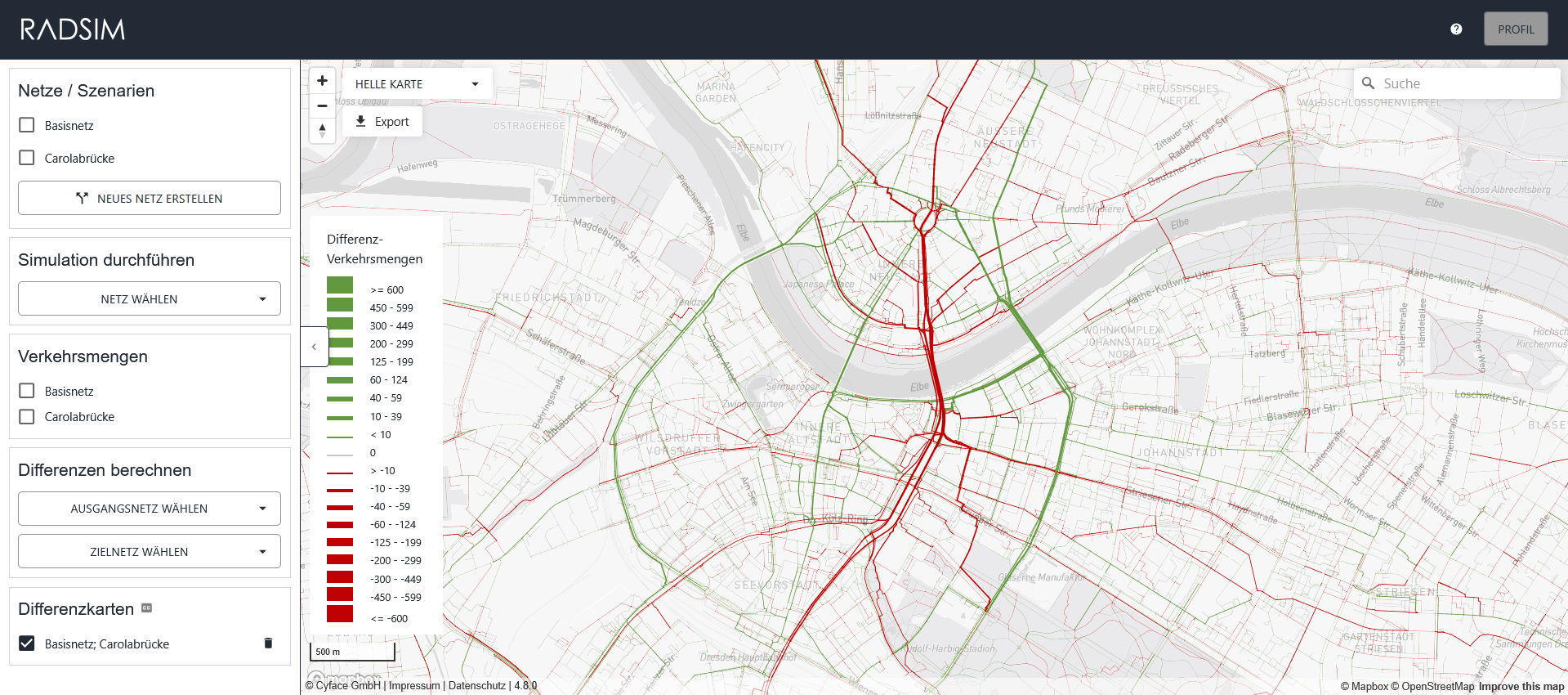 The figure shows the changes in bicycle traffic volumes in downtown Dresden following the simulated collapse of the Carola Bridge in 2024.
 -
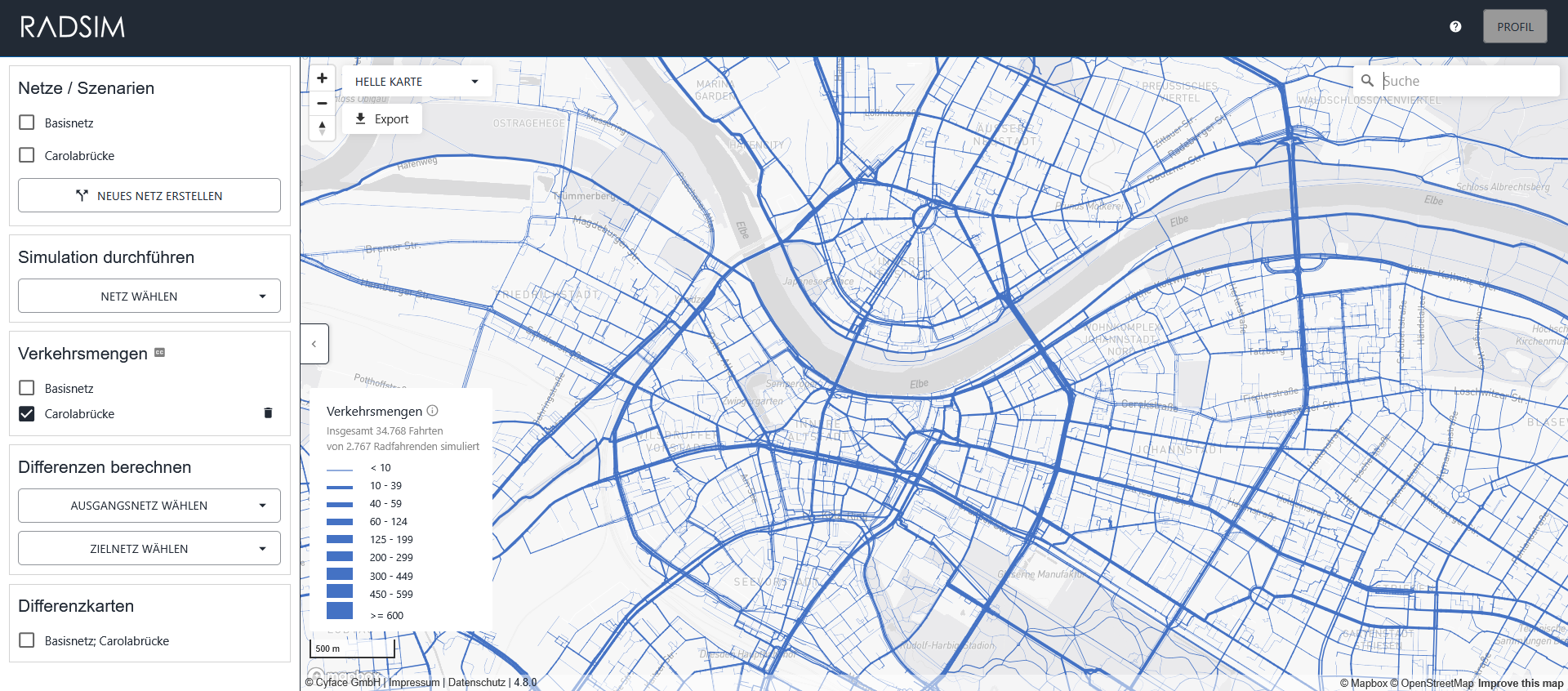 The figure shows the resulting bicycle traffic flows in downtown Dresden.
-
The figure shows the changes in bicycle traffic volumes in downtown Dresden following the simulated collapse of the Carola Bridge in 2024.
-
The figure shows the resulting bicycle traffic flows in downtown Dresden.
A better Quality of Life through better Bicycle Infrastructure Planning
It is not only municipal planning departments that benefit from these findings. Targeted bicycle traffic planning creates safer, more comfortable, and better-connected bicycle infrastructure in the long term. This can motivate more people to use bicycles for their daily commutes and, at the same time, contributes to reduced traffic noise, lower emissions, and a higher quality of life in public spaces.
With RadSim, TU Dresden is providing municipalities with a scientifically sound tool that facilitates data-driven decision-making and makes an important contribution to sustainable and future-proof mobility planning.
The research project “Bicycle Traffic Simulation for Improving Municipal Bicycle Traffic Planning (RadSim)” is funded by the Federal Ministry of Transport (BMV) using funds allocated for the implementation of the National Bicycle Traffic Plan. The total funding amounts to €621,456.74.
The platform has been available free of charge to participating municipalities in the STADTRADELN campaign with a sufficient data set since July 2026.
Content

“With RadSim, for the first time we are providing a scientific tool that allows different planning options to be simulated realistically even before they are implemented. This creates a sound basis for decision-making and helps ensure that public funds are allocated where they will have the greatest benefit for bicycle traffic and local residents.”
Dr.-Ing. Stefan Huber
Head of the “Climate-Friendly Mobility” Research Group