“Air Quality affects us all.” – Interview with Professor Erika von Schneidemesser
Since June 2026, Professor Erika von Schneidemesser has held the Chair of Air Quality and Transport at the "Friedrich List" Faculty of Transport and Traffic Sciences. Established as a joint appointment with the Helmholtz Centre Potsdam – GFZ German Research Centre for Geosciences, the professorship offers a wide range of opportunities for collaboration at the intersection of air quality, mobility, climate and health. In this interview, Professor von Schneidemesser explains why air quality is about much more than the environment, why closer collaboration between science and policymakers is essential, and what opportunities she sees in her new role at TU Dresden.
LD: Professor von Schneidemesser, what has always fascinated you about your research field of air quality and transport, and what are you most looking forward to in your new role at the Faculty of Transport and Traffic Sciences?
Professor Erika von Schneidemesser: For me, it has always been important to work on a research topic where you can directly see its impact. Air quality affects us every single day - we breathe around the clock. If we gain a better understanding of where air pollution comes from and how we can reduce it, it has an immediate positive impact on both human health and the environment. That direct connection between research and societal benefit is what truly motivates me.
At the faculty, I am especially looking forward to collaborating with experts from such a broad range of mobility and transport disciplines. Mobility is one of the key factors influencing air quality in cities, so I see high potential in combining my expertise with the faculty's diverse research strengths to address new research questions together.
LD: Your research brings together air quality, mobility, public health and climate protection. Why is it important to consider these topics as a whole rather than separately?
Professor Erika von Schneidemesser: Many policy measures affect several areas simultaneously. They often have synergies or trade-offs. Take wood burning, for example. It is frequently promoted as climate-friendly, but depending on the technology used, it can also generate significant levels of air pollution. That's why we always need to assess measures from a holistic perspective.
Our research projects also demonstrate the benefits of integrated approaches. In one study, we evaluated the redesign of a street that included the construction of a protected bicycle lane. We found that cyclists' exposure to nitrogen dioxide (NO₂) decreased by around 20 percent. Examples like this show that well-designed infrastructure can make mobility more sustainable, healthier and safer at the same time.
LD: Your work is closely connected to political decision-making processes. What role can research play in shaping more sustainable transport systems?
Professor Erika von Schneidemesser: I believe research is most effective when it is developed together with the people who will ultimately use the results. That's why I work in a transdisciplinary way, collaborating with municipalities, public authorities and other societal stakeholders.
When these stakeholders are involved from the very beginning of a project, everyone benefits. Both sides learn from each other, and the likelihood that scientific findings will actually be incorporated into planning and policymaking increases significantly. In this way, research can make an important contribution to addressing societal challenges.
LD: What opportunities does this joint professorship offer, particularly with regard to collaboration between the two institutions involved?
Professor Erika von Schneidemesser: I'm only just beginning to discover the many opportunities for collaboration. We have already launched our first joint projects within the faculty. As one example, I see enormous potential in the fields of data science and machine learning. There is already a vast amount of urban air quality data available, and by applying modern analytical methods we can gain valuable new insights for both research and real-world applications. In this context, Professor Pascal Kerschke and I have recently submitted a joint research proposal.
LD: What advice would you give to students and early-career researchers who are interested in the field of air quality and transport?
Professor Erika von Schneidemesser: The transition towards sustainable mobility is one of the major challenges facing our society, and it requires committed researchers who are eager to contribute.
What I find particularly encouraging is that universities and research institutions are increasingly collaborating with partners from government, public administration and society. This allows researchers to see how their work can contribute to real-world change and inform decision-making. That's what makes this field so rewarding for me.
LD: Thank you very much for your time. We wish you every success in your new role.
Professor Erika von Schneidemesser: Thank you very much.
Content
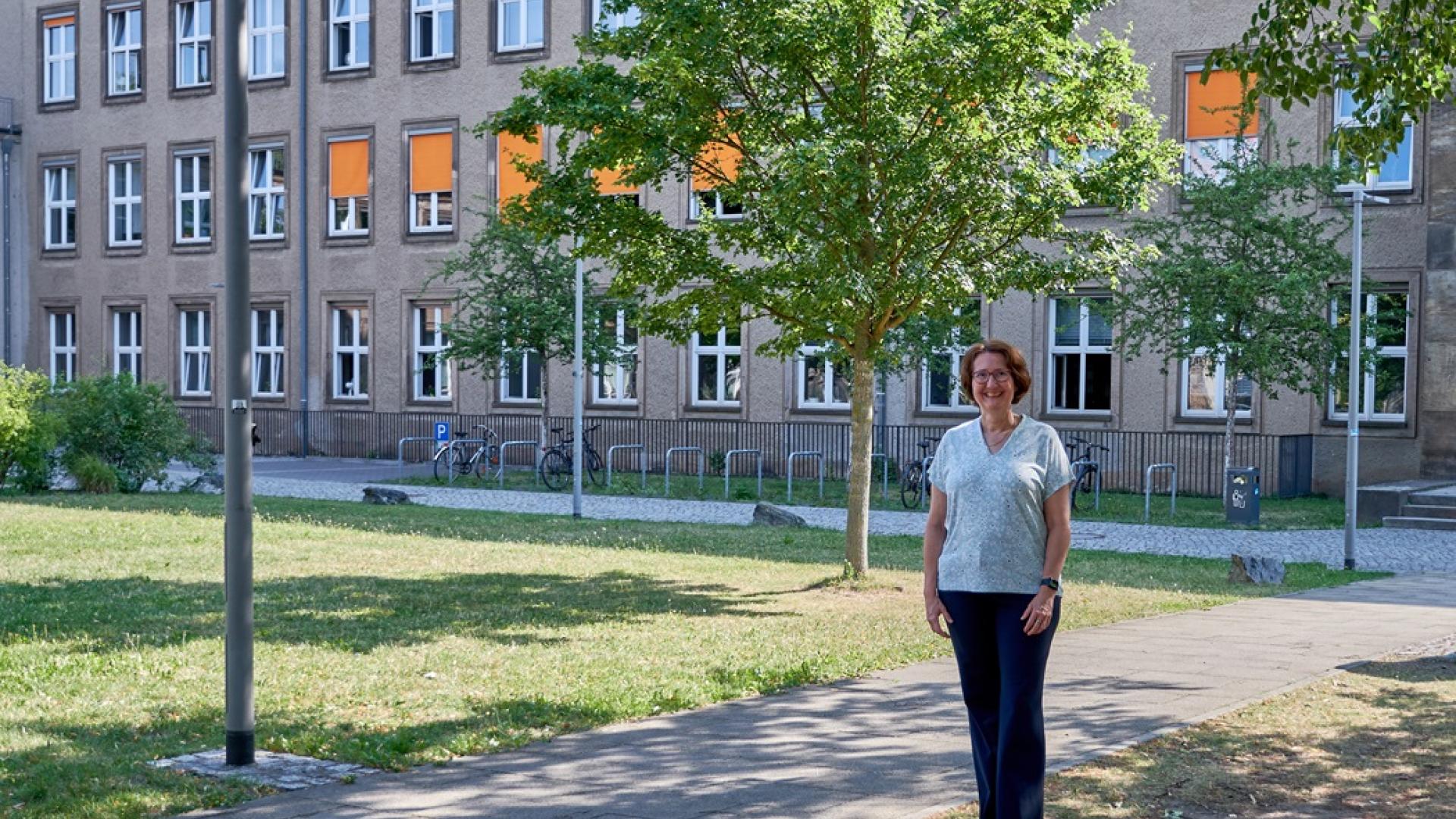
Prof. Erika von Schneidemesser
"The transition towards sustainable mobility is one of the major challenges facing our society, and it requires committed researchers who are eager to contribute."